


Embossed vacuum bags are widely used in food packaging, industrial protection, and long-term storage applications. Among different manufacturing styles, two common sealing structures are frequently used in the industry: side cut (vertical cut) and bottom cut (cross cut).
Although both types belong to the same category of embossed vacuum packaging, their structural differences lead to significant variations in performance, application scenarios, and production efficiency. Understanding these differences is essential for choosing the right packaging solution.
This article explains the structural differences and compares the advantages and disadvantages of both types in detail.
1. What Are Embossed Vacuum Bags?
vacuum bags are multi-layer plastic bags with one smooth side and one embossed (textured) side. The embossed surface creates air channels that allow efficient air extraction during vacuum sealing.
Key functions:
Improve vacuum efficiency
Prevent air trapping
Extend product shelf life
Enhance moisture and oxidation resistance
They are widely used for meat, seafood, frozen food, and industrial packaging.
2. What Is Side Cut (Vertical Cut)?
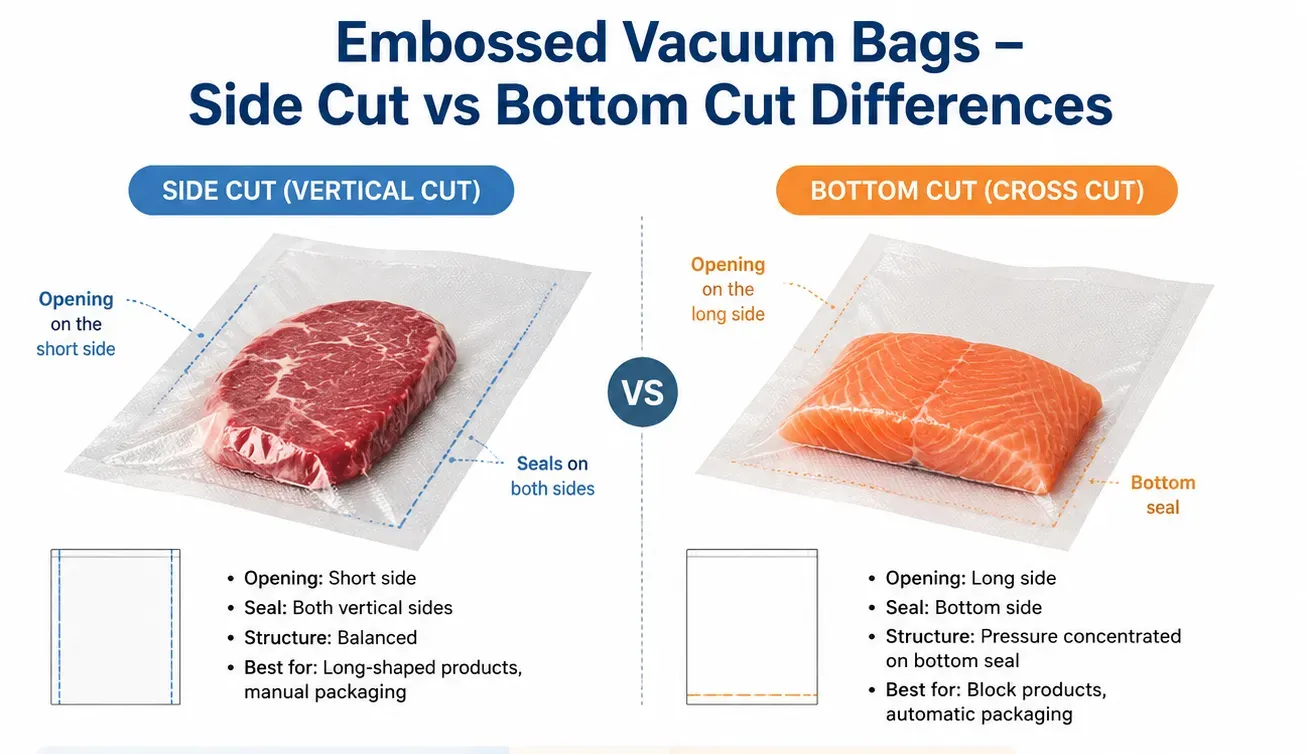
Side cut vacuum bags are produced with sealing lines running vertically along both sides of the bag.
Structural features:
Opening on the short side
Two vertical side seals
Balanced structure on both sides
Main applications:
Long-shaped products
Manual vacuum sealing operations
Household and small commercial packaging
3. What Is Bottom Cut (Cross Cut)?
Bottom cut vacuum bags are sealed along the bottom edge, forming a horizontal sealing structure.
Structural features:
Opening on the long side
One bottom seal carries main stress
More suitable for automated packaging
Main applications:
Block-shaped products
Industrial food processing
High-speed packaging lines
4. Key Differences Between Side Cut and Bottom Cut
4.1 Seal Position
Side cut: vertical seals on both sides
Bottom cut: single horizontal bottom seal
4.2 Stress Distribution
Side cut: balanced force distribution
Bottom cut: concentrated stress on bottom seal
4.3 Production Method
Side cut: simpler sealing process
Bottom cut: requires longer sealing bar and higher precision
4.4 Air Flow Behavior
Side cut: more stable air channel direction
Bottom cut: air channels may be interrupted near sealing area
5. Advantages of Side Cut Vacuum Bags
1. High Stability
Side seals distribute pressure evenly, reducing the risk of leakage.
2. Easier Production Control
Temperature and pressure are easier to maintain during manufacturing.
3. Lower Defect Rate
Fewer sealing variables lead to more consistent quality.
4. Suitable for Manual Packaging
Ideal for small-scale or flexible packaging operations.
6. Disadvantages of Side Cut
1. Lower Automation Compatibility
Not always ideal for high-speed packaging machines.
2. Slightly Limited Shape Adaptability
Less efficient for block-shaped products in automated lines.
7. Advantages of Bottom Cut Vacuum Bags
1. High Efficiency in Automation
Best suited for continuous packaging systems.
2. Better for Block Products
Ideal for meat blocks, cheese, and uniform products.
3. Faster Packaging Speed
Works well with industrial sealing machines.
8. Disadvantages of Bottom Cut
1. Higher Technical Requirement
Requires precise sealing temperature and pressure control.
2. More Sensitive to Machine Variation
Small deviations can cause sealing defects.
3. Higher Defect Risk in Production
More prone to leakage or weak sealing if not properly controlled.
9. Summary Comparison
| Feature | Side Cut | Bottom Cut |
|---|---|---|
| Stability | High | Medium |
| Automation | Medium | High |
| Defect Risk | Low | Higher |
| Production Complexity | Low | High |
| Best Use Case | Manual & general packaging | Industrial automated lines |
10. Conclusion
Both side cut and bottom cut embossed vacuum bags have their own strengths. Side cut offers stability and simplicity, while bottom cut provides higher efficiency for automated production.
The final choice depends on:
Product shape
Packaging method
Equipment capability
Quality requirements
There is no absolute better option-only the most suitable solution for each application.

