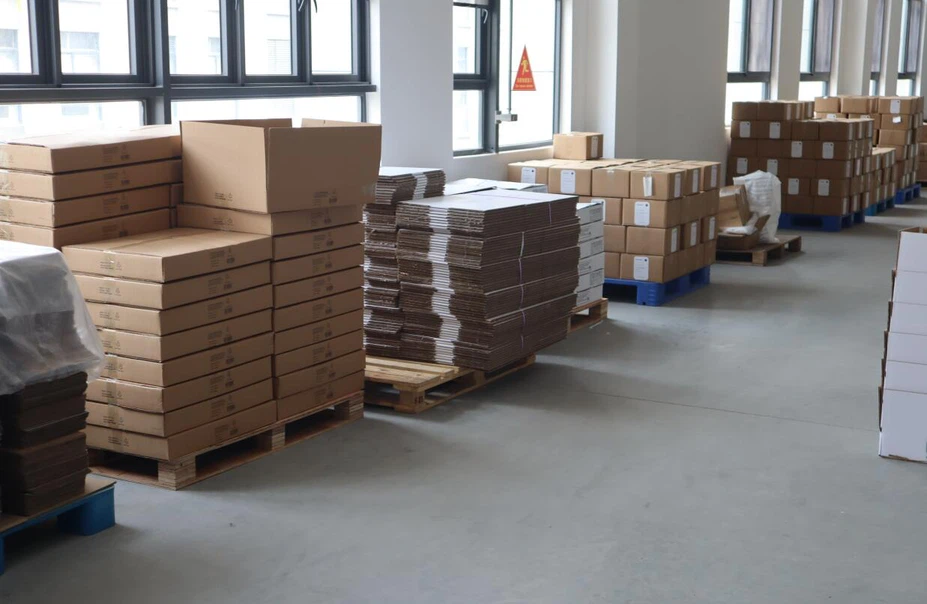
The reasonable arrangement of the warehouse of a plastic packaging bag factory is crucial to improving space utilization, facilitating cargo management and ensuring smooth production operations. The following introduces the methods and considerations of placement from different aspects:
1. Functional zoning
1.1 Raw material area: Store the raw materials such as polyethylene granules and masterbatches required for the production of plastic packaging bags separately. For example, polyethylene granules of different specifications and models should be stacked in different areas and clearly marked to avoid confusion. At the same time, the purchase time and shelf life of the raw materials should be considered, and the first-in-first-out principle should be followed to ensure the quality of the raw materials.
1.2 Finished product area: Place the plastic packaging bags in different areas according to their types, specifications, uses, etc. For example, separate polyethylene heavy-duty flat bags from ordinary plastic packaging bags, and heavy-duty flat bags can be further divided into areas according to size. Each area should be equipped with obvious signs indicating the product name, specifications, quantity and other information to facilitate quick search and delivery.
1.3 Waiting for inspection area: Used to store products that have just been produced and are waiting for quality inspection. This area should be close to the production line to facilitate the handling and inspection of products. Products to be inspected should be placed neatly and should not be mixed with qualified products to prevent quality problems.
1.4 Unqualified product area: Specially placed for unqualified products, including raw materials and finished products. Unqualified products should be marked and isolated in time to prevent them from flowing into the next production link or delivery link. For unqualified products that can be reworked, rework should be arranged as soon as possible; if rework is not possible, they should be scrapped in accordance with regulations.
1.5 Auxiliary material area: Auxiliary materials required in the production process, such as packaging tape, label paper, and packing tape, are stored. These materials should be placed in categories for easy access.
2. Stacking method
2.1 Shelf placement: For plastic packaging bags or raw materials with small volume and light weight, shelves can be used for storage. The height and number of layers of the shelves should be reasonably designed according to the space of the warehouse and the weight of the goods. The goods on the shelves should be placed neatly, following the principle of light on top and heavy on the bottom to prevent the shelves from tilting or collapsing.
2.2 Pallet stacking: For plastic packaging bags with large weight and volume, pallet stacking can be used. The quantity of goods on each pallet should be consistent, and the stacking height should be moderate, generally not exceeding 2 meters, to ensure stability. Sufficient passages should be left between pallets to facilitate the operation of forklifts and other handling equipment.
2.3 Vertical stacking: For some rolled plastic packaging bag materials, such as plastic film rolls, vertical stacking can be adopted. When stacking vertically, pay attention to keeping the roll upright to prevent deformation.
Channel setting
2.4 Main channel: A sufficiently wide main channel should be set up in the warehouse, generally with a width of not less than 3 meters, to ensure the smooth passage of large handling equipment such as forklifts and trucks. The main channel should run through the entire warehouse, connecting various functional areas to ensure smooth transportation of goods.
2.5 Auxiliary channel: In each functional area, an auxiliary channel should be set up to facilitate employees to carry out the handling and sorting of goods. The width of the auxiliary channel is generally not less than 1.5 meters.
Fire channel: Fire channels must be set up in accordance with fire regulations. Fire channels must be kept unobstructed and have a width of not less than 4 meters. No goods or debris can be stacked on the fire passage to ensure that fire trucks and personnel can quickly arrive at the scene in case of emergency such as fire.
3. Storage environment
3.1 Temperature and humidity control: The raw materials and finished products of plastic packaging bags have certain requirements for the temperature and humidity of the storage environment. Generally speaking, the temperature of the warehouse should be controlled between 10℃-30℃, and the relative humidity should be controlled between 40%-60%. Too high or too low temperature and humidity may affect the quality of plastic packaging bags, such as causing material aging and deformation.
3.2 Moisture-proof and sun-proof: The warehouse should take moisture-proof and sun-proof measures to avoid direct sunlight and rain soaking. For raw materials and finished products that are easily affected by moisture, moisture-proof mats, desiccants, etc. can be used for protection. At the same time, the roof and walls of the warehouse should be waterproofed to prevent water leakage.
3.3 Good ventilation: Keeping the air circulating in the warehouse is conducive to reducing the temperature and humidity in the warehouse and reducing the accumulation of odor and harmful gases. Ventilation equipment such as exhaust fans and ventilation ducts can be installed for regular ventilation.
4. Safety signs
4.1 Warning signs: At the entrance of the warehouse, on both sides of the aisle, above the shelves, etc., obvious warning signs should be set up, such as "No fireworks", "Be careful of forklifts", "Be careful", etc., to remind employees to pay attention to safety.
4.2 Goods signs: In addition to setting up signs in each functional area, goods signs should also be set on each cargo stack, indicating product name, specifications, quantity, production date and other information for easy management and search.
Through reasonable functional zoning, scientific stacking methods, standardized channel settings, suitable storage environment and clear safety signs, efficient management and operation of plastic packaging bag factory warehouses can be achieved.