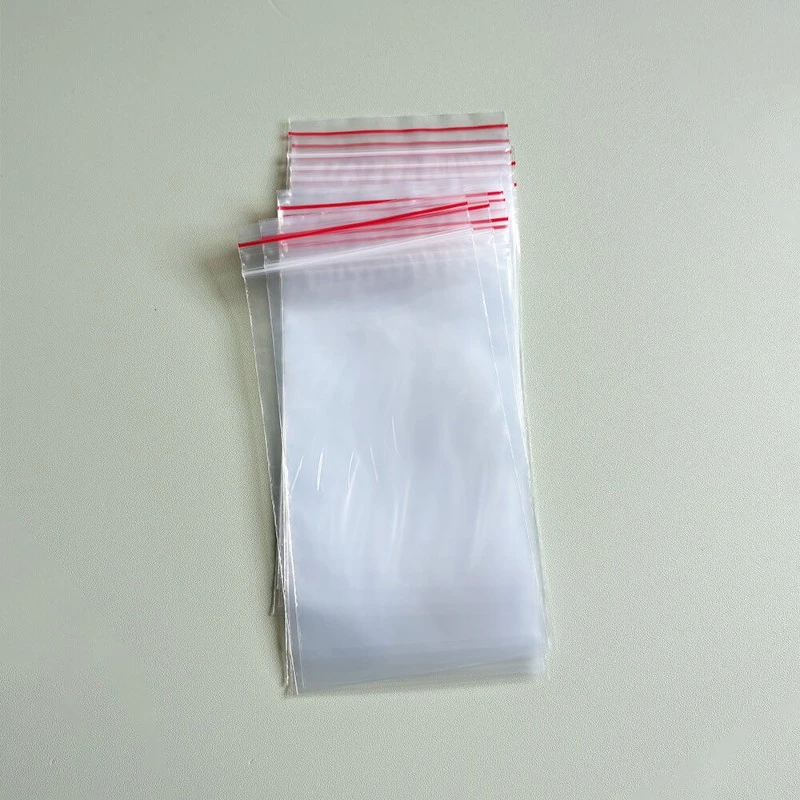

The weight capacity of small resealable clear bags typically depends on several key factors: material, thickness, size, and sealing structure. Here's an analysis:
1. Material Determines Load Capacity
Common materials are LDPE or LLDPE, which offer good flexibility and tensile strength.
LDPE generally has a medium load capacity, suitable for lightweight items.
LLDPE is more tear-resistant and has better load capacity.
Regular small LDPE resealable bags are generally used for lightweight items.
2. Thickness (Microns or Mild) is the Most Critical Factor
The greater the thickness, the stronger the load capacity.
Reference Load Capacity (General Industry Experience Values):
Bag Thickness -- Common Sizes -- Recommended Safe Load Capacity
0.04–0.05mm (approx. 1.6–2 mil) -- Small 4×6cm~8×12cm -- 20g–80g
0.06–0.08mm (approx. 2.4–3 mil) -- Small Bag -- 80g–150g
0.1mm (approx. 4 mil) and above -- Puncture-resistant Small Bag -- 150g–300g
If the bag is very small (e.g., 4×6cm), the load capacity can be higher; if the bag is larger, the load capacity will decrease.
3. The closure structure also affects load-bearing capacity.
Single-bone closure: Suitable for lightweight items such as beads, buttons, and parts.
Double-bone closure: Stronger seal, increases load-bearing capacity by 20%–30%.
Triple-bone closure: Used for higher load-bearing and leak-proof applications.
4. Load-bearing capacity reference in practical applications.
Small transparent self-sealing bags are commonly used for:
Jewelry accessories, earrings, rings (a few grams)
Screws, small hardware parts (20g–80g)
Reagent powders, granules (30g–100g)
Small electronic components (tens of grams)
It is generally not recommended to pack excessively heavy or sharp items to avoid breakage or puncture.
Most small resealable clear bags have a safe load-bearing capacity between 20g and 150g.
The greater the thickness, the stronger the closure, and the smaller the bag, the better the load-bearing capacity.